Home › Top 5 › A Very Short Introduction
Review: Schopenhauer: A Very Short Introduction — get the map before the terrain
★★★★☆4.2 / 5.0 (editorial rating)
Verdict: the right first book. A leading Schopenhauer scholar walks you through the entire system — representation, will, art, ethics — in 160 pocket pages. For anyone on first contact, and for anyone who tried the principal work cold and bounced off. Read this, and everything else on this site reads twice as fast.
- Title
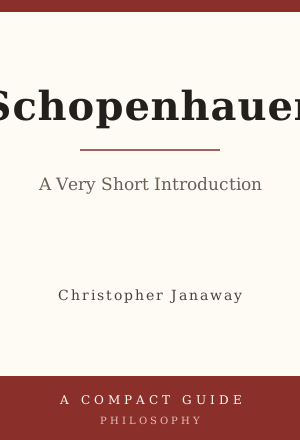
- Schopenhauer: A Very Short Introduction (Very Short Introductions #62)
- Author
- Christopher Janaway (University of Southampton)
- Publisher
- Oxford University Press (2002)
- Length
- 160 pp.
- Difficulty
- Beginner ★☆☆ — no background required
Check price & availability on the Amazon product page
What it is — in three lines
A complete tour of Schopenhauer's thought by one of its leading scholars: the fourfold root, the world as representation, the will, aesthetic experience, compassion-based ethics, and the denial of the will. Compact enough for a weekend, precise enough that nothing needs unlearning later. The map you want before entering the terrain.
Why start with a guide at all
Because the principal work assumes you already know Kant. Schopenhauer says so himself in its preface — and that honesty is exactly the problem for a modern reader arriving cold. A good guide supplies the Kantian scaffolding in plain English, so that when you finally open the original, its first sentence lands as a thesis rather than a riddle.
The world is my representation.
— Schopenhauer, The World as Will and Representation, opening sentence (editorial gloss of the German original)
Janaway spends his 160 pages making sure that sentence — and the darker doctrine of the will behind it — becomes obvious rather than mystical. That is precisely what an introduction is for.
Three highlights
1. The will, explained without mysticism
The hardest concept in Schopenhauer is the blind, striving will that underlies all appearance. Janaway builds it up from ordinary experience — your own body, wanting, striving — the same route the original takes, but with the steps numbered.
2. A fair hearing for the pessimism
Rather than treating "life is suffering" as a slogan, the book reconstructs the argument for it: satisfaction is only ever the removal of a lack, so willing guarantees pain or boredom. You can then decide whether to be persuaded — which is more respect than the slogan usually gets.
3. Where Schopenhauer sits in the story
Kant before him; Nietzsche, Wagner and Freud after. The final chapters place him in the lineage, which quietly explains why this "unfashionable" pessimist keeps returning to bestseller lists two centuries on.
What to watch out for
Two honest notes. First, "very short" does not mean easy everywhere: the opening chapters on Kant's idealism are dense, and it is fine to read them at half speed — or skim and return. Second, this is a scholar's book, not a self-help adaptation; if you want Schopenhauer applied to your morning commute, the essays themselves (On the Suffering of the World, The Wisdom of Life) do that better — in his own voice.
Check price & availability on the Amazon product page