Home › Top 5 › On the Suffering of the World
Review: On the Suffering of the World — the pessimist core, in his own voice
★★★★★4.4 / 5.0 (editorial rating)
Verdict: the best cheap ticket to the real Schopenhauer. Pocket-sized, pocket-priced, in Hollingdale's classic translation — the essays on suffering, the vanity of existence and suicide that made him the "philosopher of despair." For anyone who wants his own voice rather than a summary, and for anyone who suspects pessimism might be a strange kind of consolation. They are right.
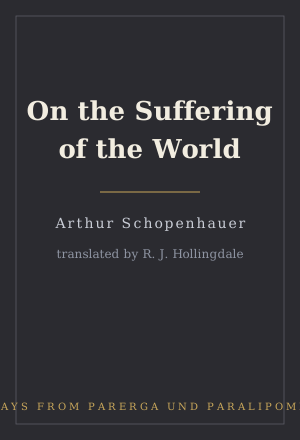
- Title
- On the Suffering of the World (Penguin Great Ideas)
- Author
- Arthur Schopenhauer, tr. R. J. Hollingdale
- Publisher
- Penguin (2004/2005)
- Length
- 176 pp.
- Difficulty
- Beginner ★☆☆ — short essays, sharp prose
Check price & availability on the Amazon product page
What it is — in three lines
A pocket selection from the late essay collection Parerga and Paralipomena (1851): on the suffering of the world, the vanity of existence, suicide, the indestructibility of our essential being, thinking for yourself, and more. Hollingdale's translation is the one that made these essays famous in English. Each piece stands alone; open anywhere.
"On Suicide" — the opposite of what you expect
"A pessimist must surely endorse suicide" — the assumption misses him completely. Schopenhauer attacks the clergy for condemning suicide without a single sound argument, and then rejects it philosophically as a false exit:
Suicide is not the denial of the will but its violent affirmation: the suicide wills life, and is dissatisfied only with the conditions on which it has been offered to him.
— Schopenhauer, "On Suicide" (editorial gloss of the argument; cf. The World as Will and Representation §69)
Wanting out of pain is itself the will-to-live crying at full volume. The real exit, he argues, lies in seeing through the will — a thread that runs straight into the fourth book of the principal work. The cold rigor of this little essay is worth the price of the volume by itself.
Three highlights
1. Suffering as rule, not exception
The title essay argues that pain is the positive, baseline condition of life and satisfaction merely its brief removal. Grim — and then, strangely, a relief: if suffering is the rule, your suffering is not your personal failure. This is pessimism's paradoxical consolation, delivered in six pages.
2. "On the Vanity of Existence" and the present moment
Only the present is real, and the present is perpetually vanishing. Schopenhauer runs this thought without any softening — and arrives somewhere oddly calm. Prose that stares at nihilism without blinking.
3. "On Thinking for Yourself"
The selection closes the loop with his famous polemic against outsourcing your thinking to books — a bracing thing to read in a book, and the best possible advertisement for reading fewer, better ones.
What to watch out for
Two honest notes. First, this is a selection, not a complete text: essays are excerpted from across Parerga and Paralipomena, and the notorious essay "On Women" is included — indefensible by modern lights; read it as a document of the man's limits, not his philosophy's core. Second, if the themes of death and suicide are close to home for you right now, start with the life-wisdom essays (The Wisdom of Life) instead — and please talk to someone rather than carrying it alone.
Check price & availability on the Amazon product page