Home › Top 5 › Parerga and Paralipomena Vol. 2
Review: Parerga and Paralipomena, Vol. 2 — the book the selections are selected from
★★★★☆4.1 / 5.0 (editorial rating)
Verdict: the complete later essays in the current scholarly translation — every piece the pocket anthologies excerpt, unabridged, including "On Reading and Books" and "Thinking for Oneself" in full. Not a first book. It is the edition you graduate to when the selections stop being enough — and the one to cite.
- Title
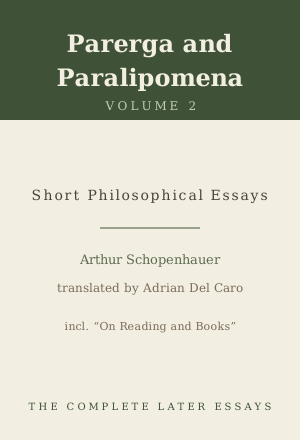
- Schopenhauer: Parerga and Paralipomena, Volume 2: Short Philosophical Essays (Cambridge Edition)
- Author
- Arthur Schopenhauer, tr. Adrian Del Caro, ed. Christopher Janaway
- Publisher
- Cambridge University Press (paperback 2017)
- Length
- ~700 pp.
- Difficulty
- Advanced ★★★ — by size and apparatus, not prose
Check price & availability on the Amazon product page
What it is — in three lines
The second volume of Parerga and Paralipomena (1851) — thirty-one chapters of short philosophical essays on logic, thinking, reading, writing, women, religion, noise, and the suffering of the world — complete and unabridged in the Cambridge Edition's current scholarly translation by Adrian Del Caro. This is the source text from which every pocket Schopenhauer anthology is cut.
The reading essays, finally complete
For readers who came to this site for Schopenhauer on reading: the famous pair lives here, complete — chapter 22, "Thinking for Oneself" (Selbstdenken), and chapter 24, "On Reading and Books" (Über Lesen und Bücher).
Reading is thinking with someone else's head instead of one's own.
— Schopenhauer, "On Reading and Books," Parerga and Paralipomena II §291 (editorial gloss of the German original)
The popular anthologies give you this line; the complete chapter gives you the argument around it — that reading is the material of thinking and becomes poison only when it replaces thinking. Note the flip-side: the budget editions of these two essays are abridged. Penguin's Essays and Aphorisms carries only a selection of the reading essay, and the old Saunders anthologies split the pair across volumes. If you want both essays whole, this volume is where they are.
Three highlights
1. Essays the anthologies skip
"On Din and Noise" (the philosopher against whip-cracking), "On Authorship and Style," the psychological observations — minor essays with major replay value that simply never make the pocket cut.
2. A translation you can cite
Del Caro's rendering with Janaway's apparatus is the current scholarly standard: numbered sections, notes on the German, and a consistent vocabulary with the Cambridge edition of the principal work.
3. The bridge back to the system
Read after the pocket selections, the complete volume shows how the one-liners hang together — the essays are outworks ("parerga") of the system, and the connective tissue is where the philosophy actually lives.
What to watch out for
Honestly: do not start here. It is ~700 pages, priced as an academic paperback, and its completeness includes the essays that are hardest to defend ("On Women" among them — read it as period damage, not doctrine). If you just want the greatest hits, the Penguin Great Ideas selection is a fraction of the price. This volume earns its place when you find yourself wanting the whole chapter behind every excerpt — a moment that, in our experience, arrives sooner than expected.
Check price & availability on the Amazon product page