Home › Top 5 › The Idea of Phenomenology
Review: The Idea of Phenomenology — the reduction, in five short lectures
★★★★☆4.4 / 5.0 (editorial rating)
Verdict: the gentlest way into Husserl's own words. Five short 1907 lectures, written before the vocabulary hardened into system, in which the phenomenological reduction is not asserted but performed. Read after Zahavi's map, "bracket the natural attitude" stops being a slogan and becomes something you watch being done.
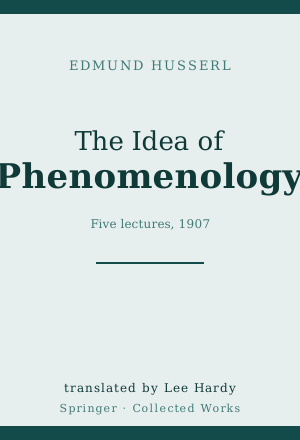
- Title
- The Idea of Phenomenology (Husserliana: Collected Works, Vol. 8)
- Author
- Edmund Husserl, tr. Lee Hardy
- Publisher
- Springer / Kluwer (lectures delivered 1907)
- Length
- Primary source · ~80 pp. (five lectures + apparatus)
- Difficulty
- Intermediate ★★☆ — short, but genuinely Husserl
Check price & availability on the Amazon product page
What it is — in three lines
In 1907, at Göttingen, Husserl opened a lecture course with five introductory lectures on the very possibility of a "critique of knowledge." Those five lectures are this book. They are the place where the phenomenological reduction first appears — the deliberate suspension of our everyday assumption that the world simply exists independently, in order to examine how objects are given to consciousness at all. Short, self-contained, and the true doorway into Husserl's own text.
Why it is the right first primary text
The problem Husserl starts from is disarmingly simple to state: how can knowledge, which happens "in here" in consciousness, ever reach objects that stand "out there"? Rather than answer with a theory, he changes the question — he brackets the assumption that there is a straightforward "out there," and looks instead at what is absolutely given, the phenomena themselves. Because these lectures were meant to introduce students, the moves are slower and more explicit than in the later systematic works. You get the reduction demonstrated at short range, which is exactly what makes the big books legible afterwards.
Set aside, for now, the question whether the world is "really" there; attend instead to how it shows itself, and to what in that showing is beyond doubt.
— editorial summary of the argument of the lectures, not a quotation of the translation
Three highlights
1. The reduction, in slow motion
Nowhere else does Husserl introduce the epoché so gradually. If the reduction ever felt like a magic word in a summary, here you see the reasoning that forces it.
2. The problem of transcendence
The lectures frame the whole of phenomenology as a response to one puzzle — how consciousness "reaches" what is other than itself. Holding that puzzle in view makes intentionality feel necessary rather than arbitrary.
3. Brevity that respects you
At around eighty pages it can be read in an evening, yet it is Husserl unabridged — no intermediary. Hardy's translation, prepared for the scholarly Collected Works, is careful and readable.
What to watch out for
Two notes. First, "short" is not "easy": these are lectures on the theory of knowledge, and a few passages will need a second pass — read it after Zahavi, not before. Second, this is an early text; some of what it opens up (the full apparatus of noesis and noema, the transcendental ego) is only worked out later, in Ideas and the Cartesian Meditations. Take it as the first move of a longer game, not the whole of it.
Check price & availability on the Amazon product page