Home › Top 5 › Cartesian Meditations
Review: Cartesian Meditations — the whole programme in miniature
★★★★☆4.3 / 5.0 (editorial rating)
Verdict: Husserl's own compact self-introduction, and the natural bridge to the big books. Five meditations that rebuild phenomenology from the ground up — from the transcendental ego to the hard problem of other minds — modelled deliberately on Descartes and then turned against him. Harder than the 1907 lectures, far shorter than Ideas.
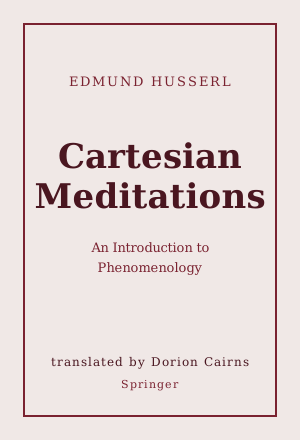
- Title
- Cartesian Meditations: An Introduction to Phenomenology
- Author
- Edmund Husserl, tr. Dorion Cairns
- Publisher
- Springer / Martinus Nijhoff (from the 1929 Paris lectures)
- Length
- Primary source · ~160 pp. (five meditations)
- Difficulty
- Intermediate ★★☆ — compact, but the Fifth Meditation is hard
Check price & availability on the Amazon product page
What it is — in three lines
In 1929 Husserl lectured in Paris on his phenomenology; he expanded those lectures into this book, published first in French. Taking Descartes' Meditations as his template, he begins where Descartes did — with a radical withdrawal to what is indubitable, the thinking ego — and then transforms the move into something Descartes never intended: not a substance to build metaphysics on, but a transcendental field in which all sense and being are "constituted." Five meditations, his own introduction to the whole enterprise.
Why it is the bridge book
Because it is Husserl's mature framework at reading length. The 1907 lectures show the reduction being discovered; here the reduction is already in hand, and Husserl uses it to lay out the full architecture — the transcendental ego, constitution, and the analysis of how objects come to have the sense they do for consciousness. Crucially, it ends with the celebrated Fifth Meditation on intersubjectivity: how, starting from my own consciousness, can there be other subjects at all? That single chapter is where phenomenology confronts the charge of solipsism head-on, and it is one of the most discussed texts in the tradition. Read this and you have the shape of Ideas in advance.
Three highlights
1. Descartes, used and overturned
Framing phenomenology through Descartes gives beginners a familiar handrail — and watching Husserl grip it and then turn it is the clearest way to see what is new in the transcendental turn.
2. The Fifth Meditation
The account of empathy and the constitution of the other is difficult, but it answers the obvious objection — "isn't this just a philosophy of my own mind?" — and it fed straight into later phenomenology.
3. Husserl introducing himself
Unlike a guide, this is Husserl choosing what to foreground for newcomers. Reading his own priorities is instructive in a way no secondary account can be.
What to watch out for
Two honest notes. First, the difficulty climbs steeply across the five meditations: the first two are approachable, the Fifth is genuinely hard, and it is fine to read it slowly or return to it. Second, do not mistake "Cartesian" for "easy Descartes recap" — Husserl uses Descartes as a starting block and quickly leaves him behind, so keep Zahavi's map nearby for the transcendental vocabulary.
Check price & availability on the Amazon product page