Review: Ideas — the first full system of phenomenology
★★★★☆4.2 / 5.0 (editorial rating)
Verdict: the summit the shelf has been climbing toward. Husserl's first fully systematic statement of transcendental phenomenology (1913), with the whole apparatus assembled at once — epoché, reduction, intentionality, noesis and noema. It is hard, and it is meant to be met last of the primary texts; with the earlier three behind you, it is the book that pays off the climb.
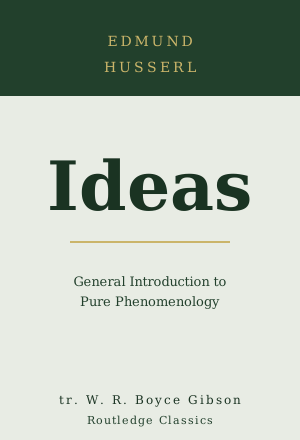
- Title
- Ideas: General Introduction to Pure Phenomenology
- Author
- Edmund Husserl, tr. W. R. Boyce Gibson (intro Dermot Moran)
- Publisher
- Routledge Classics (original 1913; this translation 1931)
- Length
- Primary source · ~450 pp.
- Difficulty
- Advanced ★★★ — the full systematic Husserl
Check price & availability on the Amazon product page / Kindle edition available
What it is — in three lines
Published in 1913, Ideas (its full title Ideas Pertaining to a Pure Phenomenology and to a Phenomenological Philosophy, First Book) is where Husserl first presents transcendental phenomenology as a complete programme. He sets out the natural attitude we normally live in, the epoché that suspends it, and the phenomenological reduction that leads back to pure consciousness — and then maps that consciousness in detail through the correlation of act and object, noesis and noema. This is the book that made "phenomenology" a movement with a method.
Why it is the summit
Everything earlier on the shelf has been preparing you to read exactly this. Zahavi told you what the terms mean; the 1907 lectures showed the reduction discovered; the Meditations gave you the mature framework in miniature. Ideas is where it is all worked out at full length and full rigour — the natural attitude, the eidetic and transcendental reductions, and the noesis/noema analysis of intentional consciousness, argued in Husserl's most systematic voice. It is the reference point the whole tradition after him argues with, including his own students. Read slowly, section by section, it rewards the effort like nothing else here.
Three highlights
1. The natural attitude and its suspension
Husserl's description of the "natural attitude" — the unquestioned belief in a world simply there — and of the epoché that brackets it is the conceptual heart of phenomenology, and it is stated here with unmatched care.
2. Noesis and noema
The full analysis of intentional experience into its act-side (noesis) and object-side (noema) is Ideas's signature contribution, and the piece of machinery later phenomenologists spent decades interpreting.
3. Husserl's 1931 preface
The Routledge Classics edition keeps the author's preface Husserl wrote for the English edition, in which he looks back on the book after two decades — a rare guided tour of a magnum opus by its own author.
What to watch out for
Three honest notes. First, do not start here: without the earlier scaffolding the terminology is genuinely defeating, which is the whole reason this shelf exists. Second, this is First Book only — Husserl planned a larger work, and the later books were published separately; the First Book is the one to read and is complete as an introduction. Third, on translations: the Boyce Gibson version reviewed here is the classic, widely available in the Routledge Classics reissue with Dermot Moran's introduction, but a more recent scholarly translation by Fred Kersten (titled Ideas I, Springer Collected Works) also exists and some readers prefer it — either is a sound choice.
Check price & availability on the Amazon product page