Home › Top 5 › The Crisis of European Sciences
Review: The Crisis of European Sciences — the life-world, and the last great work
★★★★★4.5 / 5.0 (editorial rating)
Verdict: the widest and most humane book on the shelf, and the right place to finish. Husserl's unfinished last work, where the mathematized picture of nature is shown to have buried the "life-world" we actually inhabit — and where that burial becomes a diagnosis of a crisis in European reason itself. This is why phenomenology was never merely epistemology.
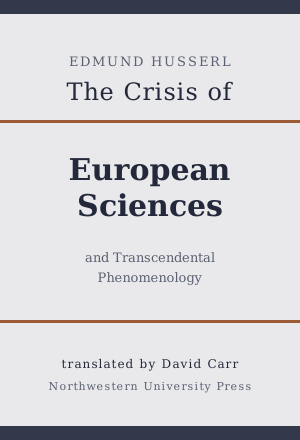
- Title
- The Crisis of European Sciences and Transcendental Phenomenology
- Author
- Edmund Husserl, tr. David Carr
- Publisher
- Northwestern University Press (from lectures of 1935–36; unfinished)
- Length
- Primary source · ~400 pp. (with the Vienna Lecture & "The Origin of Geometry")
- Difficulty
- Advanced ★★★ — wide-ranging late Husserl
Check price & availability on the Amazon product page
What it is — in three lines
Drawn from lectures Husserl gave in Vienna and Prague in 1935–36 and left unfinished at his death in 1938, The Crisis asks why the modern sciences, for all their success, seem to have lost their bearing on the questions that matter to human life. His answer runs through history: since Galileo, we have mathematized nature so thoroughly that we mistake the mathematical model for reality and forget the concrete, pre-scientific world of lived experience — the life-world (Lebenswelt) — on which every science silently rests. This Northwestern edition includes the famous "Vienna Lecture" and the appendix "The Origin of Geometry."
Why it is the destination
Because it shows what phenomenology is for. The earlier books build a method; here Husserl turns that method on the whole modern predicament and argues that recovering the life-world is not an academic exercise but a response to a genuine crisis of meaning. The life-world becomes the ground beneath both science and daily life, and the task of phenomenology becomes making that forgotten ground visible again. It is also the most influential of his works on what came after — Merleau-Ponty and much of later European thought take their cue from these pages. Read last, with the method already in hand, it lands with real force.
Three highlights
1. The critique of Galilean science
Husserl's account of how the "mathematization of nature" quietly substitutes an idealized model for the lived world is one of the twentieth century's most consequential arguments about science, and it reads with surprising urgency.
2. The life-world
The concept of the Lebenswelt — the concrete world of experience presupposed by every theory — is Husserl's most far-reaching late idea and the one that travelled furthest beyond phenomenology.
3. "The Origin of Geometry"
The short appendix on how an ideal object like geometry could arise, and be handed down, from lived activity is a classic in its own right — a compact demonstration of the whole method.
What to watch out for
Two honest notes. First, the book is unfinished and composed of layered drafts; it does not march to a tidy conclusion, and the supplementary texts matter as much as the main sections — read it as a late thinker's open workshop, not a finished treatise. Second, its historical sweep can mislead beginners into thinking it is "easier" popular Husserl; it is not — the diagnosis rests on the transcendental method of Ideas, so meet it only after the earlier four. Carr's translation and introduction are the long-standard English guide through it.
Check price & availability on the Amazon product page