Home › Top 5 › We Should All Be Feminists
Review: We Should All Be Feminists — the one-hour doorway
★★★★☆4.5 / 5.0 (editorial rating)
Verdict: the first book on feminism, with almost nothing standing between you and the idea. One short essay, read in an hour, that turns a loaded word into a clear and generous question. If you have ever wanted to understand feminism but felt you had to earn it first with a thick reading list, start exactly here.
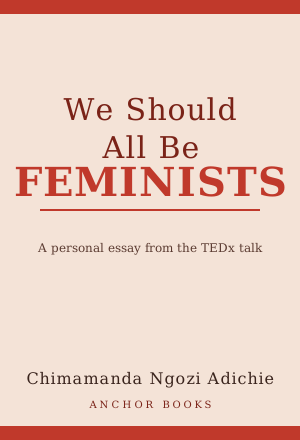
- Title
- We Should All Be Feminists
- Author
- Chimamanda Ngozi Adichie
- Publisher
- Anchor Books (2015; adapted from a 2012 TEDx talk)
- Length
- Essay · ~64 pp.
- Difficulty
- Beginner ★☆☆ — reads in about an hour
Check price & availability on the Amazon product page
What it is — in three lines
In 2012 the Nigerian novelist Chimamanda Ngozi Adichie — author of Half of a Yellow Sun and Americanah — gave a TEDx talk titled "We Should All Be Feminists." This little book is that talk, lightly expanded into an essay. Drawing on scenes from her own life in Nigeria and the United States, she reclaims the word "feminist" from caricature and offers a plain definition anyone can carry: someone who believes in the social, political, and economic equality of the sexes.
Why it can be your first book
The reason is the form. There is no jargon and no reading list to clear first — only a storyteller thinking out loud about how girls and boys are raised differently, and what that costs everyone. Adichie's method is anecdote, not polemic: a friend who calls her un-African, a waiter who thanks the man she is with for a tip she left, a childhood lesson about who is expected to lead. The argument arrives through the stories, so you never feel lectured.
Feminist: a person who believes in the social, political, and economic equality of the sexes.
— Chimamanda Ngozi Adichie, We Should All Be Feminists (editorial paraphrase of the essay's definition)
You can read it on a single train ride, yet you close it holding a usable definition and a handful of images you won't forget. For a first encounter with a subject people find intimidating, that ratio of ease to staying-power is exactly what you want.
Three highlights
1. Reclaiming the word
Much of the essay is spent gently taking "feminist" back from the sneers attached to it — humorless, man-hating, un-feminine — and showing it as something plainer and larger. Naming the caricature is half the work of dissolving it, and Adichie does it with warmth rather than heat.
2. "We teach girls…"
The essay's most quoted passages turn on how children are raised — how girls are taught to shrink themselves and to make marriage an achievement, how boys are taught that toughness is identity. Read in context, these lines are not slogans but observations you can test against your own upbringing.
3. It became a cultural object
Sampled by Beyoncé, handed to every sixteen-year-old in Sweden, quoted on T-shirts — this small book has had an outsized life. That reach is itself a reason to read the actual text rather than the memes made from it, so you meet the real, careful argument underneath.
What to watch out for
Two honest notes. First, this is a doorway, not the house. It is deliberately short and personal; it will not give you the history of the movement or the harder theoretical debates, and it isn't trying to. Treat it as the first step, with Feminism Is for Everybody and Walters's Very Short Introduction waiting to add depth and dates. Second, because it began as a talk, some readers find it slight on the page. That brevity is the point here — but if you want argument at more length straight away, jump to hooks next.
Check price & availability on the Amazon product page