Home › Top 5 › A Very Short Introduction
Review: Feminism: A Very Short Introduction — two centuries on one timeline
★★★★☆4.3 / 5.0 (editorial rating)
Verdict: the map for the middle of the journey. A slim, reliable history that lays out feminism's roots, its fight for the vote, the liberation of the 1960s, and the arguments of the present in about 160 pages. Read after the two essays, it gives every name and slogan a place on the timeline — so later debates stop feeling contextless.
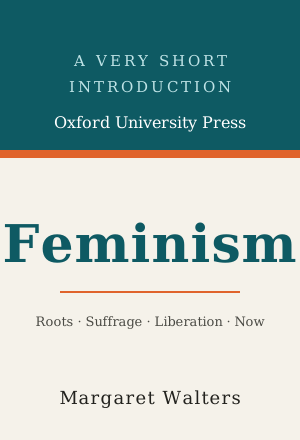
- Title
- Feminism: A Very Short Introduction
- Author
- Margaret Walters
- Publisher
- Oxford University Press (2005)
- Length
- Scholarly introduction · ~160 pp.
- Difficulty
- Intermediate ★★☆ — dense but short
Check price & availability on the Amazon product page
What it is — in three lines
This is a volume in Oxford University Press's well-known Very Short Introductions series: expert-written, pocket-sized, footnoted overviews of a single subject. Margaret Walters, a writer and critic, traces the story of feminism from early voices such as Mary Astell and Mary Wollstonecraft, through the nineteenth-century campaigns for the vote and against slavery, to the "second wave" of the 1960s and 70s and the debates that followed. It is a history, compressed but properly sourced.
Why the history matters here
The two books before this one give you the idea and its everyday stakes; what they cannot give you is the timeline. Feminism is often described in "waves," and without knowing roughly what each wave fought for — the vote, then legal and economic equality, then questions of identity, difference, and global inequality — the movement's internal arguments look like noise. Walters supplies the spine:
The vote, once the great prize, turned out to be a beginning rather than an end.
— editorial gloss of a recurring theme in Walters, Feminism: A Very Short Introduction
Set the primer's everyday politics against this two-century backdrop and the picture snaps into focus: you can see which battles were won, which were only half-won, and why feminists have so often disagreed with one another. That is exactly the footing you need before reading a contemporary essayist — or the 1949 source.
Three highlights
1. It starts before the "first wave"
Walters reaches back past the suffrage campaigns to earlier voices, so you see feminism as a long argument rather than a modern invention. That deep root changes how everything after it reads.
2. Properly sourced, in your pocket
As an Oxford introduction it carries the apparatus of real scholarship — names, dates, further reading — in a form you can finish in an afternoon. It is the rare overview you can trust and also actually complete.
3. Honest about disagreement
Rather than smoothing feminism into a single story, Walters shows its tensions — over class, race, sexuality, and nation. That honesty is what makes the later, more partisan essays legible.
What to watch out for
Two honest notes. First, it is British-leaning and it stops around the mid-2000s. The emphasis falls more on Britain than the United States, and the very recent movement — #MeToo, the online arguments, the newest debates — lies past its final page. That is by design here: Solnit's essays are the next step precisely because they carry the story into the present. Second, "very short" means real compression; some readers find the later chapters brisk. Use it as the frame, and let the books on either side of it supply the texture.
Check price & availability on the Amazon product page