Home › Top 5 › Men Explain Things to Me
Review: Men Explain Things to Me — feminism in the present tense
★★★★☆4.4 / 5.0 (editorial rating)
Verdict: the book that lands the history in the here and now. A short, witty, serious collection whose title essay put the idea behind "mansplaining" into wide circulation — and then goes well past the joke, into voice, silence, and violence against women. Read after the timeline, it gives you words for what is happening around you today.
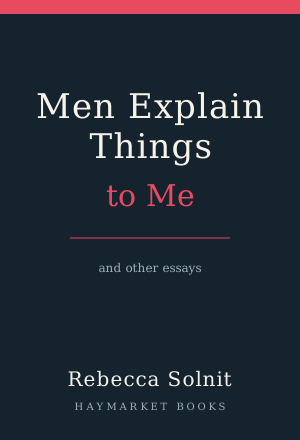
- Title
- Men Explain Things to Me
- Author
- Rebecca Solnit
- Publisher
- Haymarket Books (updated ed., 2015; title essay 2008)
- Length
- Essay collection · ~176 pp.
- Difficulty
- Intermediate ★★☆ — accessible but pointed
Check price & availability on the Amazon product page
What it is — in three lines
Rebecca Solnit is an American essayist known for a loose, associative style that ties personal anecdote to large historical currents. This slim book gathers seven essays around its famous opener, in which a man at a party lectures her at length about an important book on a subject — without realizing the book is hers. From that comic scene the collection widens into questions of who gets to speak, who is believed, and how silence is enforced.
Why it comes after the history
The title essay named a pattern so precisely that it fed a word — "mansplaining" — into everyday speech. (Solnit did not coin the term, and has said as much, but her essay is why the idea travelled.) On its own it can read as a viral anecdote; read after Walters's history, it becomes a case study in the very old problem of women's credibility.
Every woman knows what it is to have her account of the world quietly overruled.
— editorial gloss of the argument of Solnit, Men Explain Things to Me
The later essays go darker and wider — into marriage, into Virginia Woolf's love of the unknowable, into the statistics of violence against women — and this is where the collection earns its place. With the movement's history behind you, Solnit lets you name what the news and your own week keep showing you, in the #MeToo era and after.
Three highlights
1. The title essay, in full
Funny and exact, it is a small masterclass in turning one humiliating evening into a claim about power. Reading the real thing beats the thousand memes it spawned.
2. "The Longest War"
The essay on violence against women is the collection's sober heart — a reminder that the party anecdote sits on a continuum with much graver harms. It is bracing, and it is why the book is more than clever.
3. Woolf and the unknowable
The essay on Virginia Woolf turns from grievance to possibility, praising uncertainty and open horizons. It keeps the book from hardening into a single note.
What to watch out for
Two honest notes. First, this is essays, not argument-in-order. Solnit associates and digresses by design; if you want a systematic case you will feel the looseness, so read it for illumination rather than a thesis. Second, it is very much of the 2010s — its references and its temperature belong to that moment. That currency is the point at this step, but it is also why the last book is a return to the source: after the present tense, The Second Sex takes you to where the argument began.
Check price & availability on the Amazon product page