Review: The Second Sex — reading the source with your own eyes
★★★★★4.7 / 5.0 (editorial rating)
Verdict: the source the four books before it keep pointing back to. "One is not born, but rather becomes, a woman" — the starting point and the summit of twentieth-century feminism. In the first complete English translation, you can finally test that famous sentence against the 900-page argument beneath it, instead of taking it on trust.
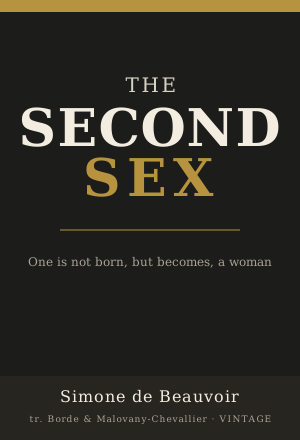
- Title
- The Second Sex
- Author
- Simone de Beauvoir
- Translators
- Constance Borde & Sheila Malovany-Chevallier
- Publisher
- Vintage (this translation 2011; original Le Deuxième Sexe, 1949)
- Length
- Primary source · ~832 pp.
- Difficulty
- Advanced ★★★ — allow 3–4 weeks
Check price & availability on the Amazon product page
What it is — in three lines
Published in France in 1949, The Second Sex is Simone de Beauvoir's vast inquiry into what it has meant to be a woman. Written from within existentialist philosophy, it examines the question from every angle Beauvoir could reach — biology, psychoanalysis, historical materialism, the myths men have made of "woman," and then the lived experience of a woman's life from childhood to old age. Nearly every strand of later feminism, in agreement or in argument, begins here.
The core — "becoming" a woman
The whole book turns on one sentence, among the most famous in modern thought:
One is not born, but rather becomes, a woman.
— Simone de Beauvoir, The Second Sex (tr. Borde & Malovany-Chevallier), opening of Volume II
"Woman," Beauvoir argues, is not a fixed natural essence but something society and history produce. The claim was revolutionary because it pulled "femininity" off the throne of natural destiny and reset it as a changeable arrangement — which is to say, something that could be otherwise. Beauvoir's key device is that man has been cast as the Subject, the default human, and woman as the Other, defined always in relation to him. The "waves" you met in Walters and the silencing Solnit describes both trace back, when you follow the threads, to the problem this book set.
Three highlights
1. The "Myths" section
The chapters dissecting how male writers have imagined "woman" are a tour de force of literary criticism, showing idealization and contempt as two faces of the same coin. It is worth the price of entry on its own.
2. Why the complete translation matters
The first English version (1953) was abridged and, translators and scholars have noted, blurred Beauvoir's philosophical vocabulary. This Borde & Malovany-Chevallier translation restores the full text, so the argument arrives intact.
3. The experience of finishing it
Reading a summary is not the same as walking the whole road yourself. When you reach the passages the four earlier books kept quoting and read them in place, feminism turns from borrowed knowledge into your own understanding.
What to watch out for
Three honest notes. First, it is genuinely hard and genuinely long — over 800 pages, steeped in mid-century existentialism, biology, and psychoanalysis. Begin here without the four steps before it and you will very likely stall; that is exactly why it sits last. Second, it is a book of 1949: some passages, especially on psychoanalysis and on race and colonial subjects, read as dated or troubling now, and are best read within their historical moment. Third, do not try to swallow it whole — the two volumes ("Facts and Myths," then "Lived Experience") are best taken a chapter at a time over several weeks.
Check price & availability on the Amazon product page