Home › Top 5 › Feminism Is for Everybody
Review: Feminism Is for Everybody — the everyday-politics primer
★★★★☆4.4 / 5.0 (editorial rating)
Verdict: the book that takes feminism out of the seminar and into daily life. Short chapters, plain language, and a definition you can actually use — hooks shows that feminism is a set of questions about work, love, class, race, and the body, not an abstraction reserved for specialists. The perfect second step after a first essay.
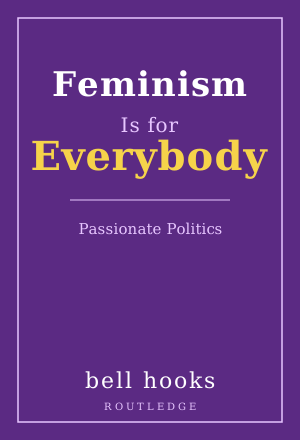
- Title
- Feminism Is for Everybody: Passionate Politics
- Author
- bell hooks
- Publisher
- Routledge (2nd ed., 2015; first published 2000)
- Length
- Accessible primer · ~124 pp.
- Difficulty
- Beginner ★☆☆ — clear, and reads in an evening
Check price & availability on the Amazon product page
What it is — in three lines
bell hooks (the pen name, deliberately lowercased, of Gloria Jean Watkins) wrote this as the primer she wished she could hand to anyone who asked, "so what is feminism, really?" In nineteen short chapters she moves across consciousness-raising, work, class, race, education, parenting, love, and the body. It is deliberately jargon-free — a distillation of decades of her more academic writing into a book "everybody" can read.
Why it belongs at step two
Where a first essay gives you the idea, hooks gives you the idea at work in ordinary life. Her definition is the spine of the whole book, and it is broader than the usual bumper-sticker version:
Feminism is a movement to end sexism, sexist exploitation, and oppression.
— bell hooks, Feminism Is for Everybody (the book's opening definition)
That phrasing does real work. By naming sexism rather than men as the target, hooks makes room for everyone in the project and heads off the "man-hating" caricature at the source. And by folding in class and race from the start, she insists that feminism cannot be only about the concerns of well-off white women — a corrective that shapes how the rest of the movement's history reads.
Three highlights
1. A definition that includes everyone
Putting sexism, not men, at the center is the book's single most useful move. It reframes feminism as something you can join rather than a side you must pick against people you love, and it does so on the first page.
2. Class and race as ground floor, not afterthought
Long before "intersectionality" became a common word, hooks insists that a feminism blind to poverty and racism is incomplete. Reading this now makes the later chapters of any movement history far easier to follow.
3. Chapters you can read in any order
Each short chapter stands on its own — beauty, work, marriage, parenting — so the book doubles as a set of clear briefings you can return to when a particular question comes up.
What to watch out for
Two honest notes. First, its brevity is bought with compression. hooks distills positions she argues at length elsewhere, so a claim that gets a paragraph here may deserve a whole book — take it as a well-lit map, not the final word, and follow the threads that grab you into her longer works. Second, it was written around the turn of the millennium; the spirit is durable but a few examples now read as of their moment. That is exactly why the next step is a proper history: Walters's Very Short Introduction supplies the dates and the long arc that a primer can only gesture at.
Check price & availability on the Amazon product page