Home › Top 5 › Philosophy of the Tourist
Review: Philosophy of the Tourist — a politics of misdelivery
★★★★☆4.2 / 5.0 (editorial rating)
Verdict: Azuma's principal work, and the heart of this shelf. The world is split into two layers — the nation (with its borders and belonging) and global capital — and neither the earnest "citizen" nor the rootless "cosmopolitan" offers much hope. In the gap, Azuma bets on the tourist: the unserious figure who crosses borders without taking responsibility, and who therefore meets the people and things they never intended to. The home of his key concept, misdelivery, and where the whole system finally comes into view.
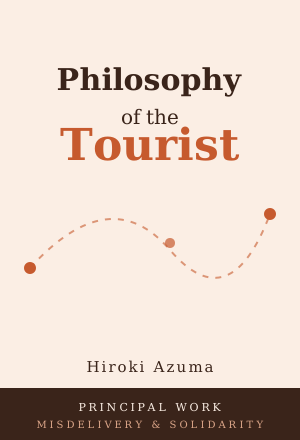
- Title
- Philosophy of the Tourist
- Author
- Hiroki Azuma (tr. John D. Person)
- Publisher
- Urbanomic (2023; orig. 観光客の哲学, 2017 / expanded 2023)
- Length
- ~320 pp.
- Difficulty
- Intermediate ★★☆ — the prose is easy; the proper names are the work
Check price & availability on the Amazon product page
What it is — in three lines
Published in Japanese in 2017 (and expanded in 2023) through Genron, the publishing house Azuma founded, this is a work of political philosophy. Running a line through the tradition — Voltaire, Schmitt, Negri — it theorizes a figure no one had made a philosophical protagonist: the tourist, recast as the bearer of solidarity in an age of division. It is his most decorated book, and the pivot of everything since.
The core — the tourist and misdelivery
The tourist takes no responsibility for the place, never becomes a serious stakeholder, and yet ends up meeting people and things they would never have met by staying home. Azuma refuses to despise this frivolity; he wagers on it. The hinge is misdelivery — the message that reaches the wrong recipient and starts something no one planned. The villager (the layer of the nation) and the pure traveler (the layer of the global) are both closed; the tourist's movement generates misdeliveries, and misdeliveries generate the accidental encounters out of which pity and solidarity can grow. What an earlier essay called a "search word you didn't know you needed" is here forged into a concept of political philosophy.
Solidarity begins not where we agree, but where a message reaches the wrong person and is answered anyway.
— editorial gloss of Azuma's argument in Philosophy of the Tourist (paraphrase, not a direct quotation)
Three highlights
1. The two-layer diagnosis
The picture of a world doubly covered — politics by the nation, economics by globalism, each running on its own principle — is worth the price on its own; the news reads a layer deeper afterward.
2. The turn to a "postal multitude"
Reworking the dead ends of Negri-style "multitude" theory through the Derridean notion of misdelivery is the book's theoretical climax — the "postal" motif from Azuma's earliest work cashed out, twenty years on, as politics.
3. Family, tourism, pity
The later stretch moves toward "the family" as a unit of solidarity, and the expanded edition's new chapters build the bridge directly to Philosophy of Correctability. This is where the sequel becomes inevitable.
What to watch out for
Two honest notes. First, it is a real work of theory — though the prose is surprisingly easy, and the walls are the proper names, not the density. Schmitt and Kojève are explained inside the book, so with Steps 1–2 (Otaku, General Will 2.0) behind you, you won't stall. Second, on editions: the English Urbanomic translation follows the expanded text, so you are getting the fuller version — but if you compare against the Japanese, note that the 2017 original lacks the later chapters that set up the sequel.
Check price & availability on the Amazon product page