Home › Top 5 › General Will 2.0
Review: General Will 2.0 — the culture critic becomes a political thinker
★★★★☆3.9 / 5.0 (editorial rating)
Verdict: the bridge. Azuma takes the database logic from Otaku and turns it on political philosophy, asking whether Rousseau's "general will" could be read off networked behavior rather than argued out in an assembly. The argument is deliberately provocative and genuinely contestable — which is precisely why it belongs before the principal works, not after. Read it as the hinge between the culture criticism and the mature politics.
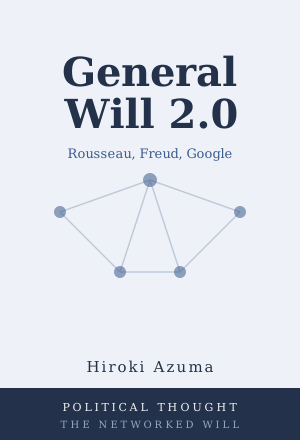
- Title
- General Will 2.0: Rousseau, Freud, Google
- Author
- Hiroki Azuma (tr. John Person)
- Publisher
- Vertical (2014; orig. 一般意志2.0, 2011)
- Length
- ~230 pp.
- Difficulty
- Intermediate ★★☆ — readable, but the argument is a wager
Check price & availability on the Amazon product page
What it is — in three lines
First published in Japanese in 2011, this is Azuma's first book-length work of political theory. It rereads Rousseau's most famous and most contested concept — the general will — with Freud on one side and networked, data-driven platforms on the other, and asks what democracy might look like if it took both seriously. The title's "2.0" is only half a joke: the wager is that the general will could be a thing to be observed rather than only deliberated.
The core — a will you can read off the network
Rousseau insisted the general will is not the sum of private opinions but something that emerges when citizens decide together. Azuma's provocation is to keep Rousseau's distinction and change its medium: the aggregate patterns thrown off by our networked behavior — the "database" of collective desire — might approximate a general will that no assembly could state. He does not want to replace parliaments with algorithms; the proposal is a dual system, deliberation checked against the unconscious of the network. Read in the age of recommendation engines and generative AI, the book's questions have only sharpened, even where its answers feel like a first draft.
The general will is not what the people say, but the pattern their behavior makes without meaning to.
— editorial gloss of Azuma's thesis in General Will 2.0 (paraphrase, not a direct quotation)
Three highlights
1. Rousseau, made strange again
The reading of the general will as something closer to a collective unconscious than a collective decision is genuinely fresh, and it sends you back to The Social Contract with new eyes.
2. Freud as the hinge
Bringing in the unconscious lets Azuma treat aggregate data as something that "wants" without deliberating — the conceptual move that makes the whole book possible, and its most defensible one.
3. The seed of everything after
The concern that runs to the principal works — how a community can stay open rather than close around a single "correct" will — is already here in embryo. Reading it first makes Philosophy of Correctability's critique of "AI democracy" land as a considered second thought.
What to watch out for
Two honest notes. First, this is the most contestable book on the shelf, and knowingly so: critics have pushed hard on whether aggregated data can carry the normative weight Rousseau's concept demands, and those objections are fair. Read it as a thought experiment to argue with, not a blueprint to adopt. Second, it is an early statement — Azuma revisits and corrects these ideas later, and Philosophy of Correctability is in part his own answer to it. Come for the questions and the turn they mark; expect the settled version further up the ladder.
Check price & availability on the Amazon product page