Home › Top 5 › The Courage to Be Happy
Review: The Courage to Be Happy — Adler, put to work
★★★★☆4.3 / 5.0 (editorial rating)
Verdict: the practical second half. Where The Courage to Be Disliked hands you the map, this sequel walks the ground — the young man, now a teacher who has hit a wall, forces the ideas to prove themselves against real classrooms and real love. The theme is "love" and "self-reliance," and the argument that love is a decision rather than a feeling is where the book earns its place. Read it right after the first.
- Title
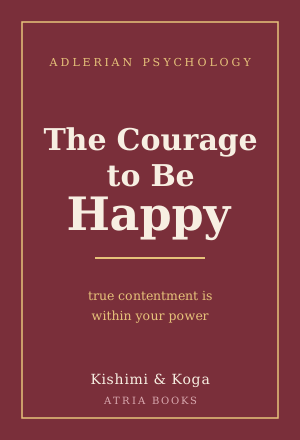
- The Courage to Be Happy: Discover the Power of Positive Psychology and Choose Happiness Every Day
- Authors
- Ichiro Kishimi & Fumitake Koga
- Publisher
- Atria Books (English edition, 2019)
- Length
- Dialogue-form sequel · ~304 pp.
- Difficulty
- Beginner ★☆☆ — same dialogue form; best read after the first book
Check price & availability on the Amazon product page / Kindle edition available
What it is — in three lines
Three years after the first book, the young man is back — and this time he has become a teacher, tried to put Adler into practice in the classroom, and failed. He returns to the philosopher not to learn the theory but to fling it back at him: "your Adler doesn't work." The book is the second dialogue that follows, and its subject is the hardest part of Adlerian psychology to live: education, self-reliance, and love. Same authors, same form, one rung further on.
The core — from understanding to living
If the first book answered "what is Adlerian psychology?", this one answers "how do you actually live it?" The teacher's complaint is concrete: without praise or punishment, how do you teach anyone anything? The philosopher's reply extends the first book's ideas into method — an approach built on encouragement rather than reward and punishment, aimed at a child's (or anyone's) self-reliance rather than their obedience. Praise, on this view, is a verdict handed down from above, and it quietly makes people dependent on being judged.
From there the book climbs to its real summit: love. Adlerian psychology, as Kishimi and Koga present it, treats love as a task you take up and a decision you make, not a feeling that happens to you — and it is through the shared life of "we," rather than the isolated "I," that a person finally becomes self-reliant and reaches the community feeling the first book pointed toward. It is the most demanding and the most rewarding stretch of the two books.
Love is not a fortune that falls on you; it is a task two people build, and the decision to keep building it. Self-reliance begins the moment "I" is remade as "we."
— the editorial room's paraphrase of the book's argument on love
Three highlights
1. It answers the objection "Adler doesn't work in real life"
By making the young man a disillusioned practitioner, the book takes the reader's own "fine in theory, useless in practice" doubt seriously, and works through it rather than around it.
2. Education without praise or blame, made concrete
The "neither praise nor scold" principle is easy to misread as permissiveness. Here it is spelled out as encouragement toward self-reliance, which is a far more exacting and interesting idea.
3. Love as the hardest task, treated as such
Rather than end on a warm note, the book argues that love and self-reliance are the steepest demands Adlerian psychology makes — an honest, bracing place to finish.
What to watch out for
As with the first book, this is Kishimi and Koga's reconstruction, not Adler's own writing — and it leans harder on their own synthesis, so the "love is a decision" argument in particular should be read as their development of Adler rather than a doctrine you will find phrased that way in the primary texts. It also genuinely depends on the first book: begin here and the returning characters and the callbacks will lose much of their force. Read The Courage to Be Disliked first, then this. Our suggested reading: take the education chapters slowly — they are the most immediately useful — and treat the closing argument on love as a provocation to sit with, not a formula to memorise.
Check price & availability on the Amazon product page / Kindle edition available