Home › Top 5 › Understanding Human Nature
Review: Understanding Human Nature — meeting Adler in his own words
★★★★☆4.4 / 5.0 (editorial rating)
Verdict: the bridge from the dialogues to Adler himself. Built from Adler's public lectures in Vienna, this is long treated as the handbook of Individual Psychology, and it is his most welcoming book — the inferiority complex, character, and the shaping of personality, laid out for ordinary readers rather than clinicians. If the dialogue bestsellers left you wanting Adler's actual voice but worried about the deep end, this is the step to take. Colin Brett's Oneworld translation is clean and current.
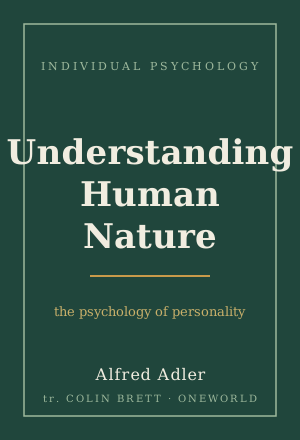
- Title
- Understanding Human Nature: The Psychology of Personality
- Author
- Alfred Adler, tr. Colin Brett
- Publisher
- Oneworld Publications (this ed. 2009; originally published 1927)
- Length
- Adler's own work (accessible) · ~256 pp.
- Difficulty
- Intermediate ★★☆ — Adler's own voice, but written for the general reader
Check price & availability on the Amazon product page / Kindle edition available
What it is — in three lines
This is Adler's own introduction to his psychology, assembled from a year of public lectures he gave in Vienna. It divides into two broad parts — human character and the life of the emotions — and moves through the ideas that made him break with Freud: the inferiority feeling and the drive to compensate for it, the unity and "lifestyle" of the whole person, memory, dreams, and the social embeddedness of every mind. Because it began as talks for a general audience, it is readable in a way clinical writing rarely is.
The core — the whole person, not the isolated trait
Adler's guiding conviction here is that you cannot understand any single trait, symptom, or choice except in the context of the whole person and their goal. A character trait is not a fixed lump of nature; it is a strategy the person has adopted, early and largely unconsciously, in pursuit of a direction — Adler's "style of life." Ambition, anxiety, cruelty, vanity: each is read as a move in a life-plan aimed at overcoming a felt inferiority and finding a place among others.
That is why the book keeps returning to community feeling as the measure of psychological health. For Adler, the questions that matter are always social — how a person meets other people, work, and love — and the traits we call problems are, at bottom, failures of that social connectedness. Read this and you can see, plainly, the primary ground from which the dialogue bestsellers drew: purpose, inferiority, the social nature of the self are all already here, in Adler's own arrangement.
No trait of character can be judged in isolation. Read it instead as a single move in the whole plan of a life — the direction a person has chosen in order to overcome a sense of smallness and find a place among others.
— the editorial room's paraphrase of the book's guiding idea
Three highlights
1. The inferiority feeling, at the source
The idea that has entered everyday language as the "inferiority complex" is set out here by the man who coined it — not as a label but as the engine of striving and, when it curdles, of neurosis.
2. Character read as strategy
Adler's treatment of individual traits as goal-directed moves, rather than fixed essences, is quietly radical and immediately useful for reading other people — and yourself.
3. Adler's own voice, made current
Brett's translation keeps the lecture-hall clarity while reading as contemporary English, so the century between you and the text mostly disappears.
What to watch out for
Two honest cautions. First, it is a book of the 1920s: some examples and some of the language around sex and gender are of their time, and are best read as period pieces rather than current science. Second, because it grew out of separate lectures, the structure can feel loose — it circles and repeats rather than building a single tight argument. Neither is a real obstacle if you come to it after the dialogues, with the key terms already in hand. Our suggested reading: treat it as Adler's own confirmation of what the bestsellers taught you — read for the ideas of inferiority, lifestyle, and community feeling in his phrasing, and don't worry if the chapters feel more like a tour than a staircase.
Check price & availability on the Amazon product page / Kindle edition available