Home › Top 5 › Essential Writings
Review: Zhuangzi — The Essential Writings — the best way in
★★★★★4.7 / 5.0 (editorial rating)
Verdict: if you read one Zhuangzi, read this. Brook Ziporyn gives you the complete Inner Chapters — the seven chapters that are the beating heart of the book — plus well-chosen selections from the rest, and, quietly alongside, short extracts from two thousand years of Chinese commentators who have argued over the hard lines. It is the rare scholarly edition that a first-time reader can simply enjoy. Its one limit is honest and on the cover: it is a selection, not the whole.
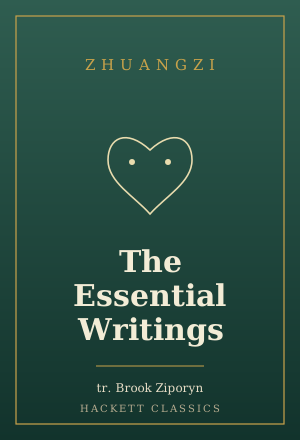
- Title
- Zhuangzi: The Essential Writings (With Selections from Traditional Commentaries)
- Author
- Zhuangzi, tr. Brook Ziporyn
- Publisher
- Hackett Classics, 2009 (original: 4th–3rd century BC)
- Length
- Selection with commentary · ~256 pp.
- Difficulty
- Beginner ★☆☆ — readable with no background
Check price & availability on Amazon / Kindle edition available
What it is — in three lines
The Zhuangzi is a foundational Daoist text from the Warring States period, a book of parables, dialogues, and jokes attributed to the philosopher Zhuang Zhou and his later followers. This Hackett edition gives you the whole of the Inner Chapters — the part scholars agree is closest to Zhuangzi himself — together with substantial selections from the Outer and Miscellaneous Chapters. What sets it apart is the running selection of traditional Chinese commentary, so you read the text and, when you need it, a hint of how it has been understood.
The core — the Inner Chapters, with help
Zhuangzi's two great moves both live in the Inner Chapters. The first is "free and easy wandering" (逍遙遊) — the image of a mind unhooked from social roles and the ranking of usefulness, roaming beyond the ordinary world; the useless tree that is never cut down and so grows huge belongs here. The second is "the equality of things" (齊物論) — the view that right and wrong, big and small, beautiful and ugly swap places depending on where you stand, so that clinging to one side of any pair is a kind of blindness.
Once he dreamt he was a butterfly, content and at ease; waking, he was a man again — and could no longer be sure whether he was a man who had dreamt the butterfly, or a butterfly now dreaming the man.
— the butterfly parable, "The Equality of Things" (editorial paraphrase, not a translator's wording)
Ziporyn's English keeps the strangeness and the humor alive instead of smoothing them into philosophy-textbook prose, and the commentary extracts do the work a good teacher would: they catch you at the moments a Western reader is most likely to stall.
Three highlights
1. The complete Inner Chapters
Many "introductions" give you scraps. This gives you the entire core of the book, so you are reading Zhuangzi, not summaries of him — and yet it never feels like the deep end.
2. Commentary that lights the path
The selections from forty-odd traditional commentators are the edition's signature. They turn passages that look like non-sequiturs into arguments you can follow, without burying the text under footnotes.
3. A translator who is also a philosopher
Ziporyn has spent a career on Chinese thought, and it shows in an introduction that actually explains why Zhuangzi matters — not just who he was. You finish it wanting the whole book.
What to watch out for
The honest caveat is simple: this is a selection, not the complete Zhuangzi. You get all of the Inner Chapters but only parts of the Outer and Miscellaneous ones, so a reader who wants every chapter should treat this as the on-ramp and move to a complete translation afterward. A second, smaller note: the commentary, wonderful as it is, can tempt you to read about Zhuangzi rather than reading him. On a first pass, let the main text carry you and dip into the commentary only where you get stuck; save the close comparison for a second reading.
Check price & availability on the Amazon product page