HINDUISM BOOK GUIDE
The 5 Best Books on Hinduism (2026)
— from a short introduction to the Gita, in reading order
A thousand gods, no single founder, no one holy book, and roughly four thousand years of unbroken practice — it is easy to freeze in front of Hinduism, unsure where a newcomer could possibly begin. But there is a stair you can climb without falling off. The mistake is starting with the scriptures or the doctrine. Get a short, expert map of the gods and rites first; meet the tradition's most-loved scripture, the Bhagavad Gita; sit with the philosophical core in the Upanishads; then take a scholar's full survey, and finally a sweeping history. This shelf lines up five books not by fame or date but in the order your understanding actually builds.
The editorial room behind this site runs a family of philosophy and religion bookshelves (a general philosophy shelf, Socrates and more) and a section-by-section reading archive of primary texts. Every recommendation rests on first-hand reading, and this shelf keeps a neutral, respectful, scholarly stance: it hands you the map and the sources, not a verdict on anyone's faith.
Our RankingRANKING
The editorial order. If you can't decide, start at #1. Check prices and availability on the Amazon product pages.
-
1
 If in doubt, start hereBeginner
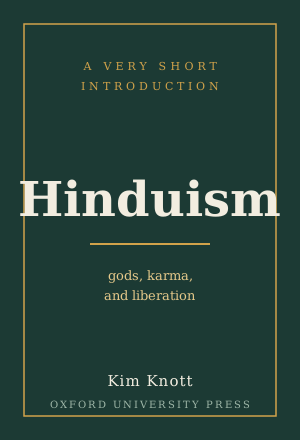
Hinduism: A Very Short Introduction
The single best map to start with. In about a hundred and forty pages, a religion scholar sets out the gods, the caste system, karma and rebirth, ritual and pilgrimage, and how a four-thousand-year tradition holds together without a founder or a single scripture. Concise, current, and even-handed — the book that lets every later reading find its place.
Check price & availability on Amazon / Kindle edition available
View on Amazon Read on Kindle Read our review -
2
 Intermediate
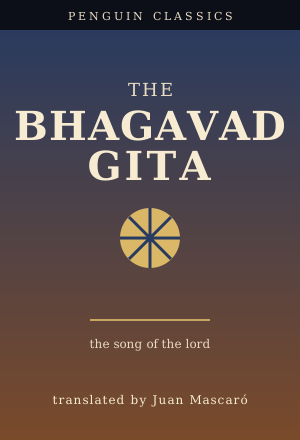
The Bhagavad Gita
Hinduism's most-loved scripture, and the natural first original. On a battlefield, the warrior Arjuna loses his nerve; his charioteer, the god Krishna, answers with a teaching on action without attachment, knowledge, and devotion. Mascaró's flowing prose translation reads like poetry and carries the heart of Hindu thought in a single short volume.
Check price & availability on Amazon / Kindle edition available
View on Amazon Read on Kindle Read our review -
3
 Intermediate
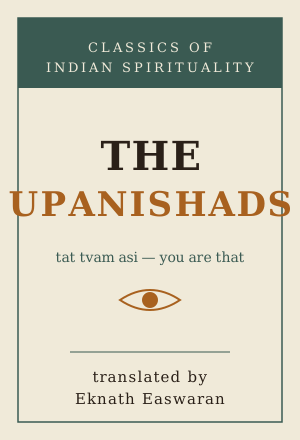
The Upanishads
The philosophical bedrock beneath everything else — the forest texts where Indian thought first asks what the self is and what lies behind the changing world, and answers tat tvam asi, "you are that." Easwaran's edition gives you a warm, readable translation of the principal Upanishads with generous introductions, so the oldest and deepest layer becomes approachable.
Check price & availability on Amazon / Kindle edition available
View on Amazon Read on Kindle Read our review -
4
 Advanced
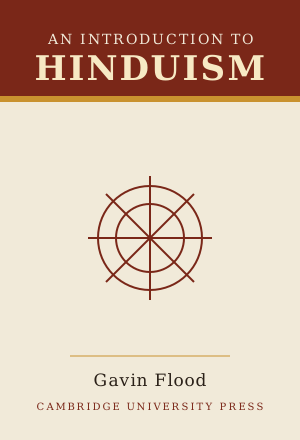
An Introduction to Hinduism
Once the short map and the scriptures are in hand, this is the scholar's full survey — the standard university introduction. Flood traces the traditions historically, from the Vedas through the great devotional movements to modern Hinduism, and is careful about the very category "Hinduism" itself. Denser than a primer, but the book that turns scattered knowledge into a structured whole.
Check price & availability on Amazon
View on Amazon Read our review -
5
 Advanced
The Hindus: An Alternative History
The deep dive and the shelf's destination: a sweeping, storytelling history that reads Hinduism from the margins as much as the mainstream — women, lower castes, animals, and the voices the standard accounts leave out. Long, learned, and much-debated, it rewards a reader who already has the map. Come to it last, and it repays every earlier step.
Check price & availability on Amazon / Kindle edition available
View on Amazon Read on Kindle Read our review
The 5 Books at a GlanceCOMPARE
The biggest worry with a subject this vast is "can I actually start here with no background?" Choose by difficulty and by type — short introduction, primary scripture, or full scholarly survey.
| Title | Difficulty | Length | Type | Best for | Links |
|---|---|---|---|---|---|
| Hinduism: A Very Short IntroductionKim Knott · Oxford | Beginner ★☆☆ | ~144 pp. ~3 hrs |
Short introduction | Reading one thing first; you want the whole map fast | View on Amazon Review |
| The Bhagavad Gitatr. Juan Mascaró · Penguin Classics | Intermediate ★★☆ | ~160 pp. ~4 hrs |
Primary scripture | You want Hinduism's most-loved text, in flowing verse | View on Amazon Review |
| The Upanishadstr. Eknath Easwaran · Nilgiri | Intermediate ★★☆ | ~384 pp. ~8 hrs |
Primary scripture | You want the philosophical core: Brahman and the self | View on Amazon Review |
| An Introduction to HinduismGavin Flood · Cambridge | Advanced ★★★ | ~341 pp. ~12 hrs |
Scholarly survey | You want the standard university-level overview | View on Amazon Review |
| The Hindus: An Alternative HistoryWendy Doniger · Penguin | Advanced ★★★ | ~779 pp. 2–3 weeks |
Narrative history | You have the map and want the deep, debated dive | View on Amazon Review |
A Reading Order That Won't Defeat YouROADMAP
People usually stall on Hinduism for two reasons: starting with the scriptures or the doctrine, and trying to memorise a thousand gods at once. Map first, then the two central scriptures, then the scholarly survey, and finally the deep history. Climb in four steps.
-
STEP 1 ── Get the map (one book)
Read Knott's Very Short Introduction for the whole landscape
Don't dive into a scripture cold. First spend an afternoon with Kim Knott's short introduction: the gods, caste, karma and rebirth, ritual and pilgrimage, and how it all coheres. The goal isn't to memorise names but to get the feel of the terrain, so everything you read next has somewhere to land.
Knott's Very Short Introduction on Amazon -
STEP 2 ── Meet the scriptures (books 2–3)
The Bhagavad Gita first, then the Upanishads
With the map in hand, read the tradition's most-loved text: the Gita, where Krishna answers Arjuna's despair with the ways of action, knowledge, and devotion — Mascaró's translation reads like poetry. Then go deeper and older into the Upanishads, whose "you are that" is the philosophical root the Gita grows from. Read the Gita for the heart, the Upanishads for the foundations.
The Bhagavad Gita on AmazonThe Upanishads on Amazon -
STEP 3 ── Take the scholar's survey
Flood's Introduction to Hinduism to tie it together
Now that the scriptures are more than names, Gavin Flood's university-level survey turns your scattered knowledge into structure — the historical development of the traditions, from the Vedas to modern Hinduism, and a careful account of what "Hinduism" even means. Denser going, but the step that consolidates everything.
Flood's Introduction to Hinduism on Amazon -
STEP 4 ── The deep history (the goal)
Take on Doniger's The Hindus: An Alternative History
With the map, the scriptures, and the scholarly survey behind you, you're ready for the destination: Wendy Doniger's sweeping, much-debated history that reads the tradition from its margins as well as its centre. It's long and learned, and only makes full sense once you know the mainstream it plays against. Reach this book and the shelf has done its job.
The Hindus on AmazonRead our review
How We ChoseCRITERIA
Three criteria. First, currently in print and actually available on amazon.com — every title has a live product page from an established publisher (Oxford, Penguin, Cambridge, Nilgiri Press). Second, the ladder must hold: short map → central scriptures → scholarly survey → deep history, each step preparing the next, with entry points at every height from a 144-page introduction to a full narrative history. Third, a neutral, respectful, scholarly stance: Hinduism is not one church but a vast family of traditions, and this shelf does not push any sect or interpretation — it hands you the map and the primary texts, and says honestly what each book is (a short introduction, a translation of scripture, a university survey, a debated history). The editorial room runs a family of philosophy and religion bookshelves and a section-by-section archive of primary texts; those first-hand readings are the foundation here.
Still Undecided? Take This OneCONCLUSION
If you have read this far and still can't choose, the answer is simple: start with Hinduism: A Very Short Introduction. In a single afternoon it gives you the gods, caste, karma and rebirth, ritual and pilgrimage — the whole map, from a careful scholar, in a hundred and forty pages. Once you have that, every scripture and history you open afterwards has somewhere to belong. When you're ready to hear the tradition in its own voice, the Bhagavad Gita is where to go next — that is this shelf's recommended route.
Check price & availability on the Amazon product pages