Home › Top 5 › The Hindus: An Alternative History
Review: The Hindus: An Alternative History — the deep, debated dive
★★★★☆4.2 / 5.0 (editorial rating)
Verdict: the shelf's destination, and its most ambitious book. A sweeping, vividly written history that tells the story from the margins — women, lower castes, animals, the outsiders the standard accounts pass over. Learned, opinionated, and genuinely controversial; read it last, when you have the map to judge it by.
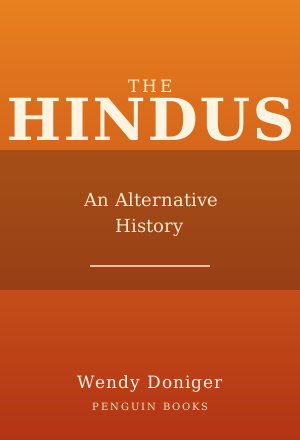
- Title
- The Hindus: An Alternative History
- Author
- Wendy Doniger
- Publisher
- Penguin Books (2010 paperback; first published 2009)
- Length
- Narrative history · ~779 pp.
- Difficulty
- Advanced ★★★ — readable prose, but long and demanding
Check price & availability on the Amazon product page
What it is — in three lines
Wendy Doniger is a distinguished (and much-discussed) scholar of Sanskrit and Indian religions, and this is her big, panoramic history of the Hindus — as distinct from a history of Hinduism as doctrine. Across nearly eight hundred pages she tells the story deliberately from below and from the edges: the experience of women, lower castes, and even animals; the myths, the dissenting voices, and the ordinary lives that formal, priestly histories tend to omit. It is scholarship written with the drive and colour of narrative — and it comes freighted with real public controversy.
Why it's the shelf's destination
Every earlier book on this shelf gives you the mainstream account: the map, the central scriptures, the standard survey. Doniger's project is to read that mainstream against the grain — to ask whose stories the tidy version leaves out, and to put them back. That is why it comes last. Its power depends on your already knowing the version it complicates; arrive here first and you would have nothing to measure the "alternative" against. Arrive here having read Knott, the Gita, the Upanishads and Flood, and the book becomes a genuine deepening — a demonstration that a tradition this vast always has more than one history.
It is also, simply, a tremendous read: erudite, funny, digressive, alive. Few 800-page works of religious history turn pages like this one.
Three highlights
1. History from the margins
By centring the overlooked — women, the low-caste, the heterodox — Doniger shows how much of Hinduism's life happened outside the official record. It changes how you read everything that came before it on this shelf.
2. A storyteller's scholarship
Doniger writes with wit and narrative momentum, weaving myth, text and social history together. The learning is deep, but it is worn lightly and delivered with real style.
3. It teaches you that history is argued
Precisely because it is a point of view — and a contested one — the book is a lesson in how histories are made and fought over. Reading it critically is part of its value.
What to watch out for
Two honest notes, and they matter. First, this is an interpretation, not a neutral textbook, and it is genuinely controversial. The book drew intense criticism and a legal challenge in India, and its publisher withdrew it there in 2014 in a settlement — an episode that itself became a landmark free-speech controversy. Critics dispute some of Doniger's readings and emphases; admirers defend her method and range. We include it as a bold, rewarding history to read critically, alongside the more consensus-oriented Flood — not as the last word. Second, at nearly eight hundred pages it is a commitment; treat it as the shelf's summit, not a starting point.
Check price & availability on the Amazon product page