EASTERN PHILOSOPHY — BOOK GUIDE
Start Eastern philosophy without giving up
Eastern thought often asks us to loosen the fixed self, notice relationship and change, and test ideas in practice rather than merely defend a doctrine. That can sound abstract. These five English books make it concrete: a brief entry into Zen, a lively Western bridge, a primary Daoist classic, an academic map, and a deep study of Zen in culture.
This is a themed guide, not a shelf devoted to one thinker. Its English-native lineup differs from the Japanese guide; D.T. Suzuki, who anchors it, wrote these works in English for Western readers. If you want to widen the view beyond Eastern thought, continue with the general Philosophy Bookshelf.
Recommended rankingRANKING
Our suggested order. If you are unsure, begin with number one. Check availability and edition details on Amazon.
- 1
 Start hereBeginner
An Introduction to Zen Buddhism
The shortest and clearest doorway on this shelf. Suzuki introduces satori, koans, and the spirit of Zen practice in a brief book written for Western lay readers.
Paperback; Kindle edition available. Check availability on Amazon.
View on AmazonRead review - 2
 Accessible bridge
The Way of Zen
A lucid, engaging bridge for Western readers. Watts traces Zen through Taoism and Indian Buddhism, then turns to its principles and practice.
Paperback; a Vintage ebook exists. Check availability on Amazon.
View on AmazonRead review - 3
 Primary classic
Tao Te Ching (Stephen Mitchell version)
A plain, poetic gateway to Daoist themes of naturalness and non-striving. Mitchell calls this a version, not a scholarly translation from classical Chinese; that readability is why it works here.
Paperback; Kindle edition available. Check availability on Amazon.
View on AmazonRead review - 4
 Moderate
Eastern Philosophy: The Basics (2nd edition)
The organizing map: a concise academic survey of major Indian and Chinese traditions, framed through metaphysical and ethical questions.
Paperback; Kindle edition available. Check availability on Amazon.
View on AmazonRead review - 5
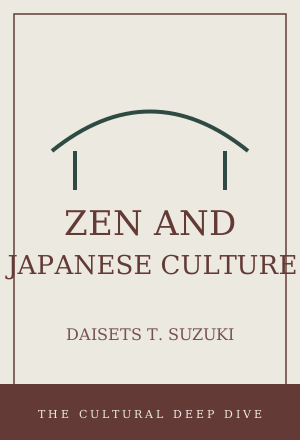 Deep dive
Zen and Japanese Culture (Princeton Classics)
A rich study of Zen embodied in swordsmanship, haiku, tea, nature, and the samurai ethos. Longer and deeper than Suzuki's Introduction.
Paperback; Kindle edition available. Check availability on Amazon.
View on AmazonRead review
Compare the fiveCOMPARE
Choose by difficulty and role in the journey.
| Book | Difficulty | Format | Role | Best for | Link |
|---|---|---|---|---|---|
| An Introduction to Zen BuddhismD.T. Suzuki | Beginner ★☆☆ | Brief paperback | Short entry | Complete beginners | Amazon Review |
| The Way of ZenAlan W. Watts | Low–moderate ★☆☆ | Paperback, ~256 pp. | Modern bridge | Readers who want a narrative overview | Amazon Review |
| Tao Te ChingStephen Mitchell version | Beginner ★☆☆ | Paperback | Primary classic | A meditative first-hand encounter | Amazon Review |
| Eastern Philosophy: The BasicsVictoria S. Harrison | Moderate ★★☆ | Paperback, ~232 pp. | Survey map | Students and systematic readers | Amazon Review |
| Zen and Japanese CultureDaisetz T. Suzuki | Moderate–advanced ★★★ | Paperback, ~608 pp. | Cultural deep dive | Curious general readers and arts lovers | Amazon Review |
A reading order that buildsROADMAP
Move from a short entry to an accessible bridge, then meet a classic directly before adding the map and the deep dive.
- STEP 1 — THE SHORTEST DOORWAY
Begin with Suzuki's Introduction
An Introduction to Zen Buddhism supplies the basic language of satori, koans, and practice without demanding prior study.
View the Introduction on Amazon - STEP 2 — THE WESTERN BRIDGE
Let Watts connect the traditions
The Way of Zen links Taoism, Indian Buddhism, and Zen in an engaging modern narrative.
View The Way of Zen on Amazon - STEP 3 — A PRIMARY CLASSIC
Read the Tao Te Ching first-hand
Mitchell's version offers a readable, meditative encounter with naturalness and non-striving.
View Tao Te Ching on Amazon - STEP 4 — THE MAP
Organize what you have met
Eastern Philosophy: The Basics places Confucianism, Daoism, Buddhist and Hindu schools, and Jainism in a structured survey.
View The Basics on Amazon - STEP 5 — THE DEEP DIVE
See Zen embodied in culture
Zen and Japanese Culture shows ideas taking form in Japanese art and life.
View Zen and Japanese Culture on Amazon
Before you buy
Amazon.com listings, available editions, and international shipping vary by location. Confirm the format, seller, and delivery terms on the listing. Kindle editions exist for all five books, but this guide does not print an unverified Kindle ASIN for The Way of Zen.
Search Amazon for D.T. SuzukiIf you choose only oneSTART HERE
An Introduction to Zen Buddhism is the natural first book: brief, clear, and written for readers with no background.
Start with Suzuki on AmazonRead the full review