Home › Top 6 › Descartes: The Project of Pure Enquiry
Review: Descartes: The Project of Pure Enquiry — who is the "I" that thinks?
★★★★★4.5 / 5.0 (editorial rating)
Verdict: the book for the reader who has climbed the ladder and wants the view questioned. Williams — one of the great moral philosophers of the twentieth century — takes the cogito you thought you understood and asks the destabilizing question: what exactly is the "I" that survives the doubt, and what was Descartes really after? His answer, the "project of pure enquiry," reconstructs the whole system as a pursuit of absolute knowledge — knowledge of the world as it is from no point of view at all. Read after the originals, it changes the color of every page you have read.
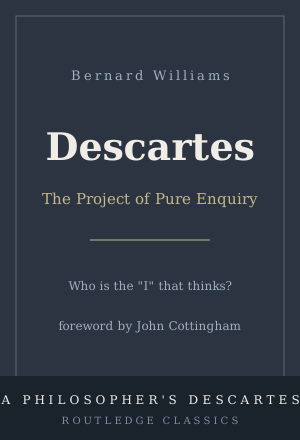
- Title
- Descartes: The Project of Pure Enquiry (Routledge Classics)
- Author
- Bernard Williams (foreword by John Cottingham)
- Publisher
- Routledge Classics (2014; first published 1978)
- Length
- 328 pp.
- Difficulty
- Advanced ★★★ — real analytic philosophy, at full pressure
Check price & availability on the Amazon product page
What it is — in three lines
A full-length philosophical study of Descartes by Bernard Williams, first published in 1978 and kept in print ever since — now in Routledge Classics with a foreword by John Cottingham, the Meditations' own translator. Not a survey and not an introduction: Williams reads Descartes the way philosophers read living opponents, reconstructing the arguments at full strength before testing where they break.
The question it reopens
By the time you finish the Meditations, the cogito feels settled: the doubt found its floor. Williams unsettles it. When the doubt has stripped away body, world, and history — what is left to be the "I"? A thing? A perspective? Or just the momentary fact that thinking is happening? And behind that puzzle he finds Descartes' deepest ambition, which he names the project of pure enquiry: the attempt to reach an "absolute conception" of reality — the world as it is independent of any observer's standpoint. That idea has escaped Descartes scholarship entirely; philosophers still argue about the absolute conception under exactly Williams' name for it. Reading this book, you watch a twentieth-century idea being minted out of a seventeenth-century text.
Three highlights
1. The cogito, taken apart
Williams' analysis of what "I think, therefore I am" can and cannot establish — what the "I" may claim, where the first person smuggles in more than the doubt allows — is the most rigorous treatment a general reader will encounter. It is the chapter that makes the passages you just read change color.
2. The absolute conception
The book's lasting invention: Descartes' science-grounding ambition reframed as the pursuit of a view of the world from no particular viewpoint. Whether that pursuit is coherent is a live question in philosophy today — and this is the book that made it one.
3. A philosopher's honesty about failure
Williams judges the proofs of God to fail, and says so — then shows what the project looks like with its theological guarantee removed, which turns out to be the condition modern epistemology actually lives in. The failure analysis is worth more than most books' successes.
Who should wait
Be warned honestly: this is analytic philosophy at full pressure, written for readers who already know the primary texts. Opened too early it reads as fog; opened after the Discourse and the Meditations it reads as revelation. It is also, unavoidably, Williams' Descartes — a reconstruction with a thesis, which specialists dispute in places. That is not a defect; it is what a great philosopher reading another one looks like. One practical note: on amazon.com this title is often stocked as a print-on-demand or marketplace paperback, so give the listing a glance before ordering; there is no Kindle edition we can currently link with confidence.
Check price & availability on the Amazon product page