Home › Top 6 › A Discourse on the Method
Review: A Discourse on the Method — the rare philosopher you can start with
★★★★★4.6 / 5.0 (editorial rating)
Verdict: your first Descartes is this book, and there is nothing to agonize over. Short, autobiographical, and the starting point of modern philosophy — almost no other primary text in the canon offers all three at once. Meet "I think, therefore I am" in the author's own telling, not in a textbook summary.
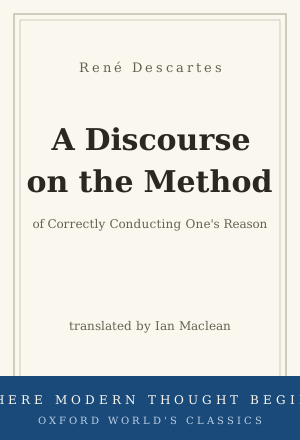
- Title
- A Discourse on the Method (Oxford World's Classics)
- Author
- René Descartes, tr. Ian Maclean
- Publisher
- Oxford University Press (translation 2006; paperback 2008)
- Length
- ~160 pp. with introduction and notes; the Discourse itself in six parts (first published 1637)
- Difficulty
- Beginner ★☆☆ — ~3 hrs; only Part Four bites
Check price & availability on the Amazon product page
What it is — in three lines
In the seventeenth century, a man who had doubted everything he was ever taught set out to explain his "method for conducting one's reason correctly" — and told it through the story of his own life. The full title promises a method for "seeking truth in the sciences." And Descartes wrote it not in scholarly Latin but in plain French: a philosophy book aimed at general readers from the day it was printed.
Why it works as a first primary text
The reason is its form. This is not a treatise; it is an intellectual autobiography. A young man finishes the best schooling of his age and admits it left him certain of almost nothing; he abandons books for "the great book of the world"; one winter, alone in a stove-heated room, he finds his rules of method; and having doubted everything, he hits the one thing that cannot be doubted.
While I was trying to think everything false, it had to be the case that I, who was doing the thinking, was something. "I think, therefore I am" stood so firm that no sceptic's wildest supposition could shake it.
— the editorial room's gloss of Part Four's argument (not Maclean's translation)
It reads like a story, and yet when you finish, the foundations of modern philosophy — methodic doubt, the cogito, mind–body dualism — are all in your hands. No other primary text in philosophy offers this ratio of narrative readability to sheer historical weight.
Three highlights
1. Part One — a disarmingly honest disappointment with learning
A man educated at one of Europe's elite schools opens by reporting that the chief profit of his studies was discovering his own ignorance. That candor sets the tone of the whole book — and a four-hundred-year-old student's disillusionment maps onto the modern reader's own with almost no translation needed.
2. Part Two — just four rules of method
Evidence, division, order, and review: Descartes compresses the logician's thousand rules into four. This short section is the ancestor of every modern problem-solving method you have ever been taught. Even a reader with no interest in metaphysics gets their money's worth here.
3. Part Four — the cogito and the proof of God
The summit of the book, and its one hard climb. Here the autobiography switches briefly into full philosophical density. It is fine not to understand all of it on a first pass — the feeling of being stopped here is precisely the best reason to pick up a guide (Sorell's Very Short Introduction) afterwards.
Where readers stall — and the editions question
Two warnings. First, as said: Part Four is hard on a first read. Keep going anyway — Parts Five and Six relax again. Second, the Discourse is in one sense a trailer for the Meditations: the cogito and the proofs of God get their full development there, so don't judge Descartes' metaphysics by this slim book alone. On editions: Maclean's Oxford World's Classics translation is our pick — modern, accurate, with a genuinely useful introduction. The Hackett edition (tr. Cress) is the common US classroom alternative and often cheaper; either will serve, and waiting for the perfect edition is just another way of not reading the book.
Check price & availability on the Amazon product page