Home › Top 6 › Introducing Descartes: A Graphic Guide
Review: Introducing Descartes: A Graphic Guide — the lowest doorway in
★★★★☆4.0 / 5.0 (editorial rating)
Verdict: if a page of seventeenth-century prose makes your shoulders rise, start here. One illustrated hour puts the life, the dreams, the doubt, the cogito, and the mind–body problem in your head as pictures — and every book you read afterwards gets easier. It is scaffolding, not the building; used as scaffolding, it earns its place on this list.
- Title
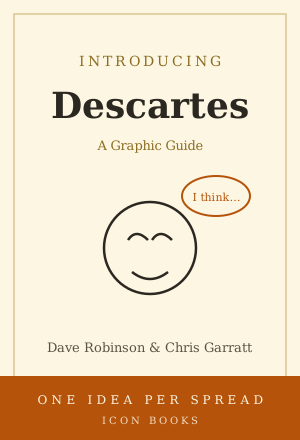
- Introducing Descartes: A Graphic Guide
- Authors
- Dave Robinson (text), Chris Garratt (illustrations)
- Publisher
- Icon Books (2010, Graphic Guides series)
- Length
- 176 pp.
- Difficulty
- Beginner ★☆☆ — ~1 hr
Check price & availability on the Amazon product page
What it is — in three lines
An entry in Icon Books' long-running Graphic Guide series: Descartes' life and thought told through illustrated spreads, one idea at a time. Robinson's text keeps the argument moving; Garratt's drawings — the same team behind several other guides in the series — keep it landing. From the soldier's wanderings to the Swedish winter that killed him, with the doubt and the cogito in between.
Why pictures first actually works
Philosophy defeats new readers less by difficulty than by unfamiliarity: every sentence introduces a term, a stake, and a century all at once. An illustrated guide solves the unfamiliarity problem in advance. After an hour here you know who the Jesuits were to Descartes, why he stayed in bed until noon, what the evil demon is for, and where the pineal gland enters the story — so when you meet them again in the Discourse or the Meditations, they are acquaintances, not strangers. The drop in resistance is real and measurable in pages-per-sitting.
Three highlights
1. The life as the spine
The guide follows the biography — school, army, travels, the stove-heated room, Holland, Sweden — and hangs the ideas on it. Since the Discourse itself is autobiographical, this is the right spine: you are pre-reading the original's own structure without knowing it.
2. The doubt, staged
Dreams, deceiving senses, the evil demon: the escalation of methodic doubt is inherently visual, and this is the rare format that can actually show it. The demon spread alone is worth the cover price for a first-timer.
3. The aftermath included
The guide doesn't stop at the cogito. It sketches the mind–body problem Descartes left behind and the centuries of pushback — so you finish knowing not just what Descartes said but why everyone since has been arguing with him.
What it can and cannot do
Be honest about the format. A graphic guide compresses arguments into captions; nuance is the price of the speed, and you cannot cite it in an essay. It is also, inevitably, one interpretation — Robinson has to pick a reading of the cogito and run with it. None of this matters if you use the book as designed: as one fast hour that lowers the wall before the primary texts. It replaces nothing on this list; it makes everything else on the list more likely to be finished.
Check price & availability on the Amazon product page