Home › Top 5 › The Individual Psychology of Alfred Adler
Review: The Individual Psychology of Alfred Adler — the whole system in one volume
★★★★☆4.5 / 5.0 (editorial rating)
Verdict: the summit of this shelf and the standard English reference on Adler. The Ansbachers took Adler's scattered, uneven, sometimes contradictory output and built it into a single systematic presentation — selections from his writings, arranged by theme, stitched together with lucid editorial commentary. It is long and demanding, closer to a graduate textbook than a trade book, but nothing else gives you the entire architecture of Individual Psychology in one place. For the reader who has done the earlier steps, it is the payoff.
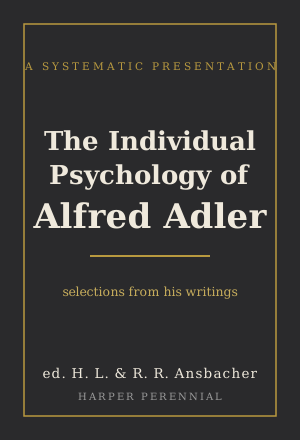
- Title
- The Individual Psychology of Alfred Adler: A Systematic Presentation in Selections from His Writings
- Author / Editors
- Alfred Adler; edited by Heinz L. & Rowena R. Ansbacher
- Publisher
- Harper Perennial (originally published 1956)
- Length
- Scholarly compendium · ~500 pp.
- Difficulty
- Advanced ★★★ — comprehensive and dense; the reference volume
Check price & availability on the Amazon product page
What it is — in three lines
Adler never wrote a single systematic treatise; his ideas are spread across lectures, essays, and popular books, and they shifted over time. In 1956 Heinz L. Ansbacher and Rowena R. Ansbacher solved that problem: they selected from across his writings and arranged the pieces into a coherent, chapter-by-chapter presentation of the whole theory, adding editorial introductions that place each selection and explain how it fits. The result has served for decades as the authoritative English-language source on what Adler actually held.
The core — a system assembled from fragments
The book's achievement is architecture. Instead of a chronological reader, the Ansbachers organise Adler by concept — the striving from a felt minus toward a plus, the unity of the personality and the "style of life," social interest (their preferred rendering of Adler's community feeling), the tasks of life, the theory of neurosis — so that ideas scattered across thirty years line up as parts of one structure. Their connecting commentary is genuinely part of the value: it flags where Adler's terms drifted, where he contradicted himself, and where later readers have misunderstood him.
Read after the dialogues and Adler's own popular books, this is where everything you have gathered gets its foundations. The teleology of The Courage to Be Disliked, the three tasks of What Life Could Mean to You, the character analysis of Understanding Human Nature — all of it reappears here in its fully articulated, cross-referenced form, with the scholarship to back it.
Adler left no single system, only a scattered body of work; the achievement of this volume is to assemble those fragments into one architecture — striving, unity of the person, social interest, the tasks of life — with the seams honestly marked.
— the editorial room's characterisation of the book's method
Three highlights
1. The most complete map of Adler in English
Breadth is the point: concepts you meet only in passing elsewhere are here set in their place within the whole, with sources given. As a reference it is close to indispensable.
2. Editorial commentary that earns its keep
The Ansbachers do not merely reprint; they interpret, reconcile, and correct. Their apparatus is what turns an anthology into a system, and it is unusually candid about Adler's inconsistencies.
3. "Social interest," clarified
Their careful handling of Gemeinschaftsgefühl — the term the bestsellers render as "community feeling" — is a small master class in why translation matters for this thinker.
What to watch out for
Be clear-eyed about what this is: a scholarly reference, not a book to be read straight through in a weekend. The prose (Adler's and the editors') is academic, the selections demand attention, and at five hundred-odd pages it rewards study rather than a single sitting. It is emphatically not a first book on Adler — come to it only after the dialogues and, ideally, Adler's own popular works, or the density will defeat you exactly as the roadmap warns. One more honest note: because it is an edited assembly, the arrangement and emphasis are the Ansbachers' scholarly reconstruction of Adler's system, expertly done but still an interpretation of how the fragments best fit together. Our suggested use: treat it as a reference to move through by theme — read the editors' introduction to each part first, then the selections — and return to it as questions arise, rather than forcing a cover-to-cover march.
Check price & availability on the Amazon product page